School District’s House Daily Opportunities

Vendors often imagine there is a single system where all school district RFPs are posted, a kind of national clearinghouse. The reality is more complex. School district procurement functions as a decentralized network, shaped by state statutes, local governance, regional service agencies, and the administrative preferences of more than 13,000 districts. Opportunities appear daily across a broad constellation of platforms, each reflecting a different procurement tradition. Finding these opportunities reliably, therefore, requires not only familiarity with the major bid-notification companies but also an awareness of the structural gaps they cannot bridge.
Procurement monitoring begins with understanding where districts publish solicitations. Many use well-established procurement systems such as Bonfire, IonWave, Vendor Registry, Public Purchase, BidNet, or GovSpend’s acquisition tools. Others depend on smaller municipal systems or post solicitations directly to district websites. Regional cooperatives, including Educational Service Centers (ESCs), Boards of Cooperative Educational Services (BOCES) networks, or the Cooperative Purchasing Connection (CPC), also issue multi-district solicitations that vendors often miss because the language appears more regional than industry-specific.
The private bid-notification sector attempts to bring order to this complexity. Platforms such as GovSpend, StarBridge, GovWin, and BidNet aggregate solicitation from a mixture of scraping tools, direct feeds, and public postings. Each operates with a distinct logic. Some focus on education-specific categories, while others provide general government-wide feeds. Vendors often assume that subscribing to one or two platforms guarantees comprehensive coverage, yet the decentralized nature of K–12 procurement creates visibility gaps that commercial systems cannot eliminate.
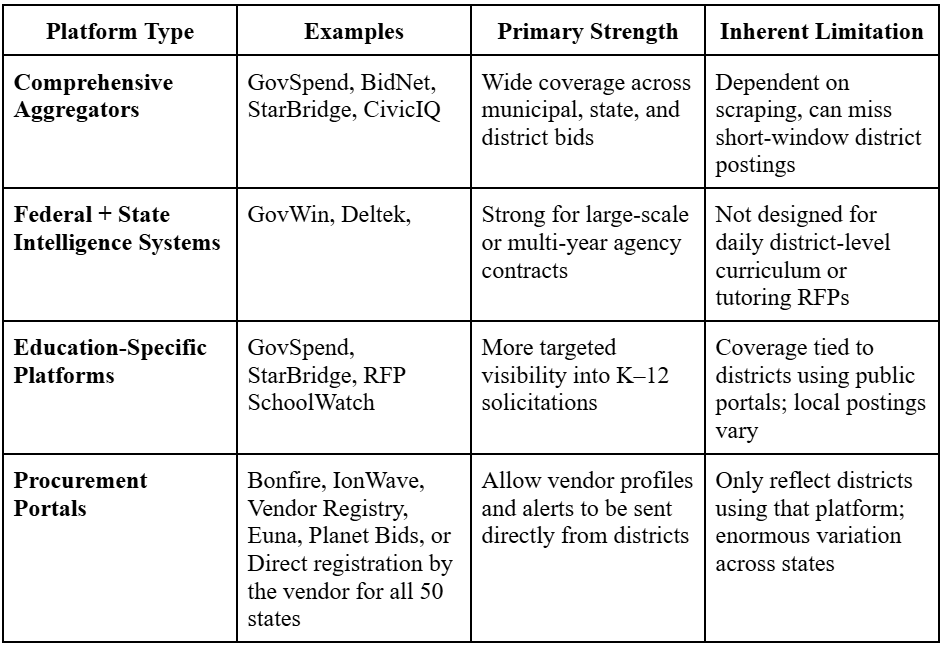
These systems play a meaningful role, yet they work best when understood as supplementary rather than definitive. Districts sometimes post solicitations for only a few days, particularly renewals or smaller purchases that exceed local thresholds. Some publish exclusively through board agenda attachments without duplicating the notice on a procurement portal. Others upgrade systems, change vendors, or revise political directives around posting practices. No commercial system can consistently capture these subtleties. An indictment of the platforms, but a structural reality of public-sector procurement.
This is why state-level registration is an essential counterpart to commercial monitoring. Each state maintains its own procurement portal—Texas SmartBuy, California eProcure, New York State Contract Reporter, Georgia Procurement Registry, and others. When vendors register at the state level, they receive real-time notifications from agencies, state education departments, and cooperative entities. These notices bypass scraping lags and deliver primary-source procurement data. Although registration requires time and maintenance, the benefits are significant: the vendor becomes part of the state’s official vendor ecosystem rather than a passive observer of scraped opportunities.
Many states also require vendors to complete specific commodity code selections, historically based on NIGP or UNSPSC classifications. When these codes are selected carefully, state-level alerts become more precise. When selected broadly, they become cluttered. The discipline of refining commodity codes forces vendors to interpret their market position through the lens of public-sector classification systems, which, in turn, can influence product strategy and proposal positioning.
State registration matters for another reason: districts sometimes leverage state systems to satisfy statutory posting requirements. A solicitation may appear only on a state portal even if the district uses a local procurement system for vendor onboarding. Vendors who skip state-level registration create blind spots that appear trivial until a missed opportunity reveals their significance.
Daily school district opportunities rarely emerge through one channel. Monitoring requires a layered approach: commercial platforms for breadth, state-level registration for authoritative notices, district portal alerts for frequent RFP cycles, cooperative systems for multi-district solicitations, and governance monitoring for early signals of future procurement. This layered approach replaces the illusion of centralization with a disciplined structure for interpreting public-sector behavior.
Board agendas remain one of the most overlooked sources of procurement insight. Districts often discuss upcoming textbook adoptions, technology transitions, tutoring initiatives, facilities upgrades, and assessment replacements during committee meetings long before RFPs appear. These discussions reveal timelines, budget constraints, political dynamics, and implementation considerations. Vendors who follow these signals gain preparation time that their competitors lack. Scholars studying organizational learning describe this form of early signal detection as “pre-decisional awareness,” where institutions reveal their priorities through informal communication channels before formal documentation exists (March, 1994).
It is also essential to recognize that district procurement cycles reflect local conditions. Staffing shortages, superintendent transitions, legislative mandates, and shifting enrollment patterns can influence the timing and nature of solicitations. Vendors who interpret district behavior solely through posted RFPs may misunderstand the underlying forces shaping those decisions.
Daily opportunity discovery requires predictable internal rhythms. Teams must review alerts, assess applicability, evaluate readiness, and make pursuit decisions consistently. Vendors who treat monitoring as a daily practice rather than an intermittent activity develop a deeper understanding of district patterns, allowing them to anticipate opportunities before they appear formally.
The distribution of school district RFPs across systems is not disorder; it reflects decentralized public governance. Vendors who cultivate the discipline to monitor this landscape with nuance, structure, and cross-functional awareness develop an advantage that exceeds the value of any single platform. Real-time visibility emerges not from relying on one tool but from integrating multiple sources, each offering a different window into how districts articulate their needs.
Write Way Consulting
Your partner in research-based strategy, K–12 expertise, and sustainable organizational growth.
References
Institute of Education Sciences. (2022). Using Evidence Under ESSA.
MDRC. (2021). Building Evidence for Education Programs.
